

Chto Delat or What is to be done is an artist group from Saint Petersburg explicitly demanding for a reevaluation of left values. An exhibition of their work is on display at the Institute of Contemporary Art in London. Here can be seen the video which was part of the exhibition: http://vimeo.com/12130035. The video stems from the documentation of the art collective of the social and political actors intervening in a controversial plan to build in the center of St Petersburg “the Okhta Center with a Gazprom skyscraper”. But more than this the video shows Russian society divided by fractures ironically sung about.
A photographer and documentarist, Meiselas is most famous for her work on Central America both through the use of photographs and film. The most important body of work she did, from my point of view, concerns the portrait of a revolution (the Sandinist revolution in Nicaraguain the 1980s) by registering history in its making which she characterizes as follows: “what happened in Nicaragua, I wanted to register the voices of the subjects that are embedded, I hope, as objects in my photographs. By knowing and recognizing its limits, the voice of the protagonist within the picture, challenges the image as a fixed moment in time” (see more).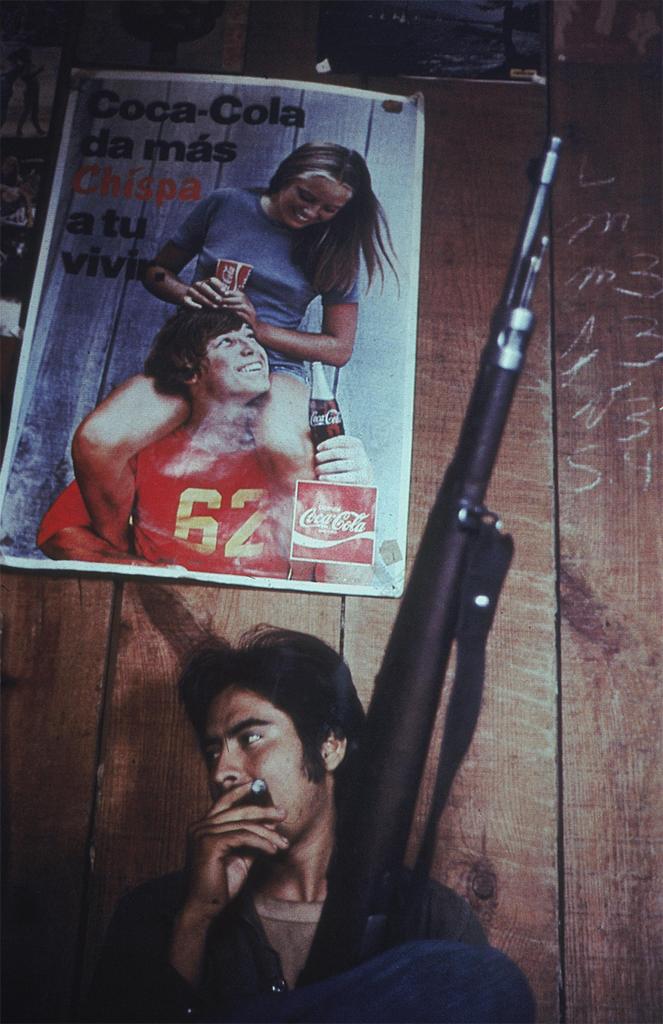
Reading time: 1 min
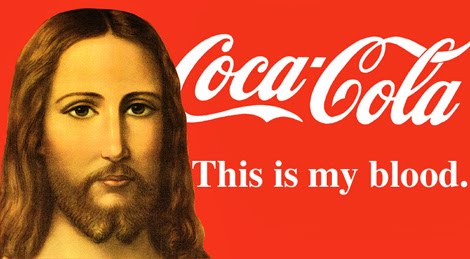 Kosolapov is a very interesting artist which mixes symbols or icons of both the West and the East in his work (a representative of Sots art, an ironic Soviet version of the Westerners Pop art). An exiled artist in New York during the Cold War he is most famous for his Lenin+ Coca Cola works; the mixing is the most interesting part of his work as it helps bring irony to the images created (see the Lenin series on the artist website at: www.sotsart.com).
Reading time: 1 min
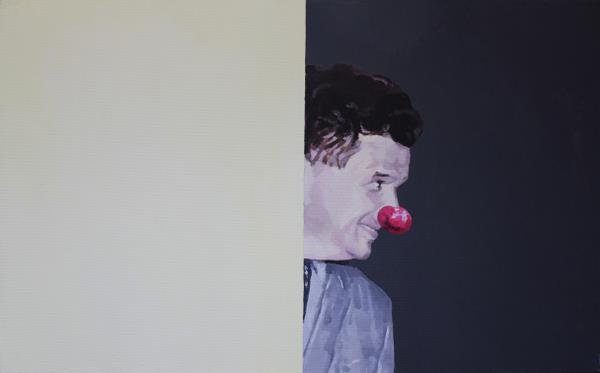 Dragos Burlacu, from the Understanding History series
This is one of the paintings by Dragos Burlacu who used the newly available photographic archive of communism to paint new, less familiar images of Ceausescu including stills of the dictator having fun, with his family, almost in intimacy. The laughing, clownish Ceausescu makes me think of the portrait of the ridicule that was transposed onto his image after 1990 when he became only the illiterate shoemaker (or alternatively the tyrant) that ruled us for so many years. The intention of the painter seems to me close to that of Ujica and Grigorescu which I was mentioning in my previous post: humanize the dictator or at least provide a more complete image of his persona. Ceausescu the clown in the gray on gray atmosphere alludes to his other history; not to be forgotten, still to be explored.
PS: the disinterment of the Ceausescu couple (July 21, 2010) has made them all so present again in the media, so I guess the title I chose was not so wrongly coined!
* allusion to the stencil showing Ceausescu and the tag: I’ll be back (see below)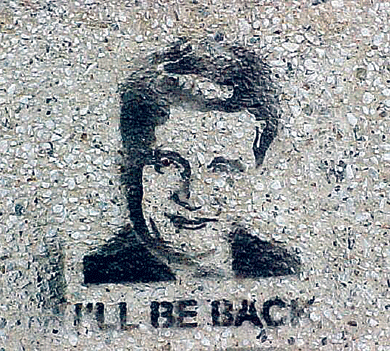
Reading time: 1 min
A new docu-film was launched yesterday at the Cannes film festival by a Romanian director, Andrei Ujica, “The autobiography of Ceausescu”. The film is made of various archive images of Ceausescu. What seemed very interesting to me in this piece of news is the way the movie is announced: it humanizes the dictator. This reminded me of another filmic “re-construction”, that of Ioan Grigorescu who continued in 2007 a previous work (Dialogue with Ceausescu, made in 1978) by showing a new imagined dialogue with the now defunct dictator: “Post-mortem dialogue with Ceausescu”. This piece of art had the same purpose as Ujica’s: present Ceausescu in a realist light, showing all sides of the character and affirming that his demonization and caricaturization have provoked the loss of the true man.
I believe this is an interesting phenomenon, part of our artistic memorialization of Ceausescu. Perhaps we’ll even have next the occasion to read a novel of the dictatorship!
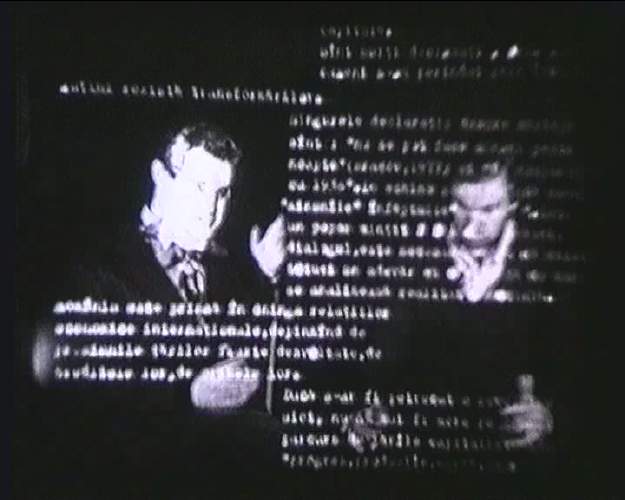 Ion Grigorescu, Dialogue with Ceausescu, 1978
Reading time: 1 min
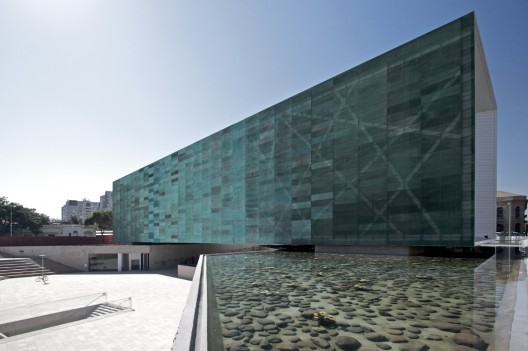
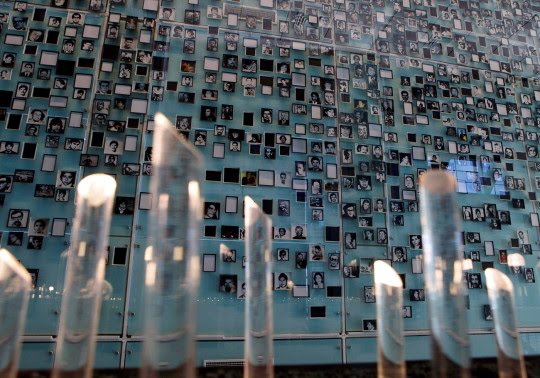
Artistic memory represents one of my topics of interest of the moment. I am discovering several ways in which art is used to remember the dictatorial past as well as manners in which art memorizes the past (independently of a political order). Currently I am looking at the official memory of art through the establishment of museums in South America. Chilean president Michelle Bachelet ended her term by inaugurating (as Chirac did in 2006 with Musee du Quai Branly although with a higher symbolic weight in the Chilean case) the Museum of Memory and Human rights in Santiago de Chile. Such museums exist in several parts of Argentina (Museum of Rosario), including Buenos Aires where the infamous ESMA has been (partially) transformed in a museum. A museum of memory was opened in Uruguay and another one in Asuncion, Paraguay. A plan to open a museum has been also discussed in Peru in the aftermath of the regime of Fujimori and the repression launched against the Shining Path; there already is a small museum in Ayacucho as well as a permanent exhibition (Yuyanapaq) in Lima’s museum of art.
Reading time: 1 min
the anonymity of the character is part (if not the most important part) of the street artist (turned film maker with the screening of his first “pseudo-documentary” at the Sundance festival) Banksy. where does the anonymity end and the branding begin (from street, fugitive art he has been transformed in a gallery sold artist) is another question. Banksy makes art with no official approval, even despite it, and he is sold, and famous for it. I wonder where would Banksy find himself in the planned – by the Romanian Union of Visual Artists – law to create an “official statute” of the artist to be confirmed by a committee or something as such.
Reading time: 1 min

I recently saw two great exhibitions at the Metropolitan Museum of Art in New York. The first one was the presentation of the work by American photographer, Robert Frank, The Americans, an album in fact dating of 1959. Frank shows America the way he saw it by traveling across the country in 1955-1956. So many opposite images: political men, the desertness of the paysage, the new Hollywood stars, the diners, the poor, the left behind, the blues and the open horizon.
The second exhibition, American Stories looked at American painting of the everyday in the period 1765-1915 and spoke of the American society. The political was present everywhere: be it race discrimination, be it women disenfranchisement etc. What struck me is the way the two exhibitions could have been thought of together. Maybe because it was my first encounter with America, I saw these paintings also as historic snapshots, just as Frank’s photos. They spoke of the construction of a nation, of its different components, faces and perspectives. I particularly loved this one, by Winslow Homer (American, 1836–1910), Dressing for the Carnival (1877).
 The third element to my American equation was the Kandinsky superb exhibition at the Guggenheim. I was not a particular fan of K (I loved the painting that opens the exhibition) but the expo greatly recaptures his evolution in parallel to politics. He is the artist that invokes the right to create “art for art”, not tainted or influenced by the politics of the time. In his search for the spiritual in art he leaves aside the political.
Still at the Guggenheim I saw the work of an English artist, Anish Kapoor entitled Memory that seems so right these days when all is talked about is the memory of 1989. His work has to be seen on site to feel its weight, to be confronted to the feeling of asphyxiation. I of course took the literal translation of the work and saw it as the unbearable weight of the past… (a link to a recent show by Kapoor in England)
Reading time: 1 min